Something Borrowed, Something Balkan: Why Gen Z Is Trading the Wedding Industrial Complex for Their Roots
There's a moment at every American wedding — usually somewhere between the overpriced floral centerpieces and the DJ playing "September" for the fourth time in an hour — where you wonder if anyone is actually having fun, or if everyone is just performing fun for the Instagram reel. It costs somewhere north of $30,000 to produce that performance, by the way. The average American wedding in 2024 ran about $35,000. For a single day.
A growing number of young Balkan Americans have looked at that number, looked at their family's photo albums from weddings in Sarajevo, Belgrade, Zagreb, and Skopje, and said: ne hvala.
No thanks.
What's happening in Balkan diaspora communities across the US right now is genuinely fascinating — not just as a cultural story, but as a kind of quiet rebellion. Gen Z kids who grew up straddling two worlds are choosing to get married in a way that would feel completely familiar to their grandparents, and completely alien to their American coworkers. And they're doing it without apology.
The Wedding Industrial Complex Has a Balkan Problem
American wedding culture is a machine. There are vendors, packages, timelines, and a deeply ingrained idea that the amount of money you spend is proportional to how much you love your partner. Wedding planners. Engagement shoots. Bridal suites. Rehearsal dinners. Farewell brunches. By the time you're done, you've essentially produced a small film festival, except the only subject is you.
Balkan weddings — the real ones, the ones baka and dedo talk about — don't work like that. They're events that unfold over multiple days, hosted largely at home or in community spaces, fueled by food that relatives started cooking three days earlier, and soundtracked by live music that nobody planned but everyone expected. The wedding is the community. The community is the wedding.
For young Balkan Americans, that contrast has become impossible to ignore. "I went to my cousin's American wedding and it was beautiful, but it felt like a production," says one 26-year-old from the Chicago Bosnian community who asked to remain anonymous because, as she put it, "I don't want drama before my own wedding." "My mom kept whispering to me about how much everything probably cost. Then we went to a wedding back home the next summer and it was just... alive. People were crying and dancing and arguing and eating at the same time. That's what I want."
Traditions That Never Actually Left
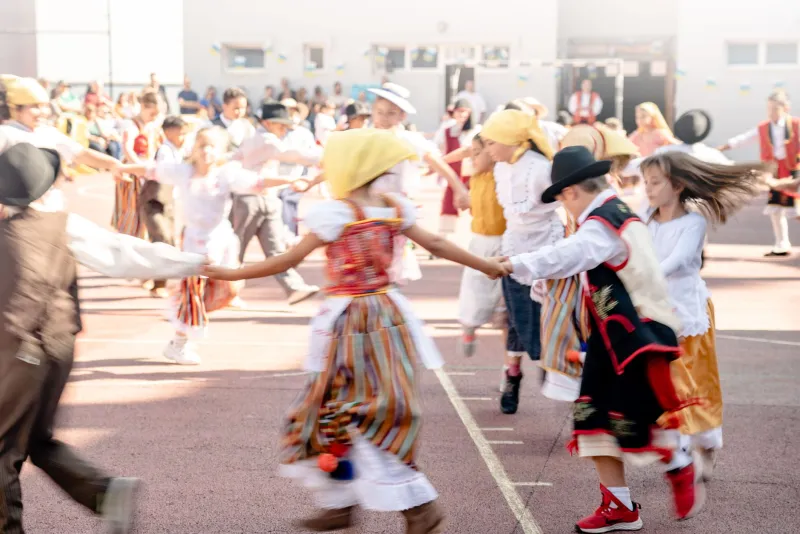
Here's the thing about Balkan wedding traditions — they didn't disappear in the diaspora. They went underground. They got compressed into a Saturday afternoon, squeezed into a rented hall in Astoria or Dearborn or St. Louis. The kolo still happened, just a little shorter. The rakija still flowed, just a little more quietly. The folk songs still got sung, usually by an uncle who'd had enough drinks to stop being self-conscious about it.
What Gen Z is doing now is decompressing all of that. Giving it room to breathe again.
The slava — the Serbian Orthodox celebration of a family's patron saint — has seen a genuine resurgence among younger diaspora families, sometimes woven directly into wedding celebrations as a way to anchor the event in something sacred and specifically theirs. The darovi tradition, where guests bring practical gifts rather than registry items, is making a comeback as a rejection of the consumerist gift registry model. Even the deveruša and kum roles — the groomsman and godfather equivalents that carry deep ritual weight — are being reclaimed by young couples who want their wedding party to mean something beyond matching outfits.
Social media, maybe unexpectedly, is a big part of why this is happening. TikTok and Instagram have given young Balkan Americans a way to see their own traditions reflected back at them — not as something old-fashioned or embarrassing, but as something genuinely cool. Videos of Balkan wedding dances rack up millions of views. Clips of emotional moments during traditional ceremonies get shared across diaspora communities worldwide. For a generation that grew up feeling like their culture was invisible in mainstream American life, suddenly seeing it go viral is no small thing.
DIY Doesn't Mean Cheap — It Means Different
It's worth being clear: this isn't just about saving money, though that's certainly part of the appeal. It's about a different set of values entirely.
Many of the young couples leading this trend are spending money — just differently. Instead of a wedding photographer who charges $8,000 for a "cinematic experience," they're hiring a photographer from within the community who understands what moments actually matter. Instead of a catering company, they're pooling resources with family members who each bring a dish they've been making for decades. Instead of a venue deposit, they're using a family property, a community center, or a backyard strung with lights.
The result isn't a lesser wedding. It's a different kind of wedding — one where the labor itself is a form of love. Where the fact that your tetka made the baklava matters as much as how it tastes. Where the wedding is something the community builds together, rather than something a couple purchases.
"We spent maybe $8,000 total," says a 28-year-old from the New Jersey Serbian community who got married last summer. "And it was the best party I've ever been to in my life. My grandparents danced. My American friends said it was the most fun wedding they'd ever attended. Nobody missed the photo booth."
What This Moment Actually Means
There's something bigger happening here than just wedding planning choices. For Balkan Americans — a community that has often felt caught between worlds, too American for the old country and too Balkan for mainstream America — the wedding has become a site of identity reclamation.
Choosing a Balkan wedding isn't just rejecting American consumerism. It's an assertion that this culture, these traditions, this way of celebrating life together, is worth preserving. Worth passing on. Worth being seen.
In a country where assimilation has historically meant flattening your edges, there's something quietly radical about a 25-year-old in New Jersey saying: we're going to do the kolo, we're going to make the pita, we're going to let my uncle sing until 2 AM, and we're not going to apologize for any of it.
Baka, for what it's worth, is thrilled.