Swipe Right on Tradition? How Balkan Americans Are Rewriting the Rules of Love
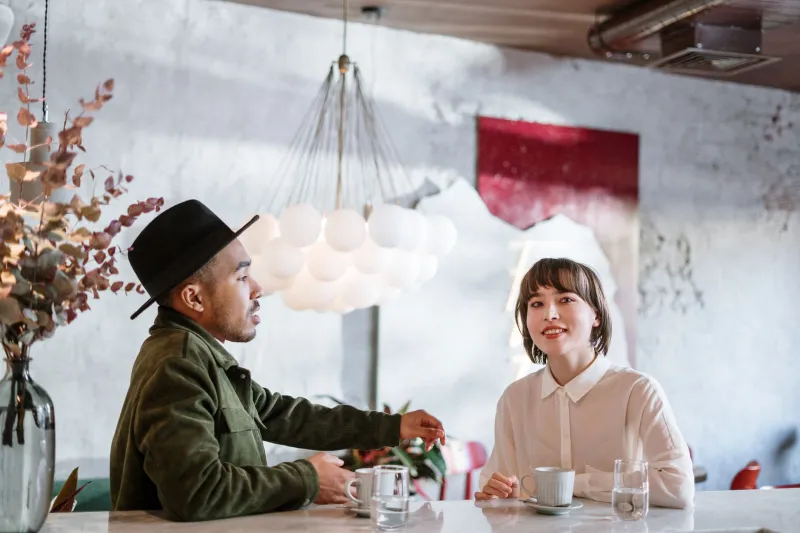
Imagine you're twenty-six, living in Chicago or Phoenix or Jersey, and you've just matched with someone on Hinge. Pretty normal millennial experience, right? Except that in the back of your head, you can already hear your mama asking whether they're from a good family. And your tata wondering why you're not just marrying that nice kid from the community whose parents they've known for thirty years.
Welcome to the Balkan American dating paradox — where the heart wants what it wants, but the family group chat has opinions.
The Love Script Nobody Asked For
If you were raised in a Balkan household in the US, you probably absorbed a very specific set of unspoken rules about romance before you ever went on a first date. Relationships were serious business. You didn't casually date around — you found someone with intention. Parental approval wasn't a nice-to-have; it was basically a prerequisite. And the whole concept of "figuring yourself out" in your twenties through a string of situationships? That was not in the handbook.
For many Balkan American millennials and Gen Zers, these values were absorbed almost by osmosis — through watching how their parents interacted, through community gatherings where coupling up young was quietly celebrated, through the stories of how baka and deda met and married young and made it work for fifty years.
The tension kicks in when that script collides head-first with American dating culture, which operates on an almost entirely different set of assumptions. Here, independence is prized. Taking years to "find yourself" before committing is not just acceptable — it's encouraged. The idea that your parents would weigh in on who you're seeing, let alone have a say in the relationship's future, reads as wildly intrusive to most Americans.
Two Dating Cultures, One Very Confused Person
Mira, a 28-year-old Bosnian American from St. Louis, describes the experience as "living in two romantic realities at once." She grew up watching her American friends date casually, break up, move on, and treat the whole thing as a normal part of self-discovery. Meanwhile, every relationship she entered felt weighted with a different kind of significance.
"When I started dating someone seriously, my mom wanted to know everything — his family, his job, his plans," she says. "And I get it, because that's how she understood love. But my boyfriend at the time thought it was really intense. He'd never had a girlfriend's mom basically do a background check."
That friction — between the Balkan instinct toward collective investment in romantic decisions and the American emphasis on individual autonomy — is something relationship therapist Dr. Ana Petrović, who works with immigrant and second-generation communities in the New York metro area, sees regularly in her practice.
"Second-generation clients often come in carrying what I call inherited romantic anxiety," she explains. "They've absorbed their parents' values around commitment and family, but they're also living in a culture that tells them those values are old-fashioned or even controlling. The internal conflict is real and it's exhausting."
The App Problem
Then there's the small matter of dating apps, which have basically become the default infrastructure for modern American romance. For Balkan Americans, swiping through Tinder or Bumble introduces a whole new layer of complexity.
On one hand, apps offer something genuinely liberating — the ability to meet people completely outside of family or community networks, without anyone knowing, without the social weight of "what will people say." For some second-gen Balkan Americans, that anonymity is a relief.
On the other hand, the casual, low-stakes nature of app dating can feel deeply at odds with how they were raised to think about relationships. When your cultural baseline is that you date someone because you could see marrying them, the concept of a "talking stage" that goes nowhere for three months feels almost disrespectful.
Darko, 31, a Serbian American in Los Angeles, put it bluntly: "I downloaded Hinge and within two weeks I was so overstimulated I deleted it. Not because I couldn't get matches — but because the whole thing felt like shopping. My parents met through mutual friends, got engaged after eight months, have been married thirty years. And here I am trying to figure out if someone's 'emotionally available' based on their answer to a prompt about pineapple on pizza."
Rejecting the Playbook — Kind Of
Here's the thing, though: most Balkan Americans aren't actually rejecting their parents' values wholesale. The picture is way more nuanced than that.
What's happening is more of a selective remix. Many second-gen Balkan Americans are quietly holding onto the parts of their inherited love culture that feel meaningful — the emphasis on loyalty, on meeting families, on taking relationships seriously — while pushing back on the parts that feel outdated or suffocating, like the pressure to marry young, the expectation of parental veto power, or the stigma around dating outside the community.
Sofia, a 24-year-old Croatian American from Cleveland, describes her approach as "Balkan values, American timeline." She's not in a rush to get married just because her cousins back in Zagreb are already on their second kids. But she also has zero interest in the non-committal situationship culture she watches her American roommates navigate.
"I want what my parents have — like, the depth of it, the commitment," she says. "I just want to get there on my own terms, not because someone's family pushed us together at a community event."
The Community Factor
Of course, it's impossible to talk about Balkan American dating without acknowledging the community itself as a force. Diaspora communities across the US — whether in Chicago, Detroit, New York, or the Pacific Northwest — are tight-knit in ways that make dating feel semi-public. Everyone knows everyone. Your breakup becomes neighborhood news. There's a reason so many Balkan Americans describe dating within the community as both deeply appealing and genuinely terrifying.
For those who do find partners within the diaspora, there's an ease that's hard to replicate elsewhere — the shared shorthand, the food that needs no explanation, the holidays that don't require a cultural orientation session. But that same closeness can feel like a fishbowl when things go wrong.
Finding Their Own Path
What's emerging, slowly and sometimes messily, is a generation of Balkan Americans building their own romantic frameworks from scratch. They're borrowing from both cultures, discarding what doesn't fit, and figuring out the rest through trial, error, and a lot of late-night phone calls with their mamas — who, it turns out, often have more wisdom to offer than their kids initially gave them credit for.
The paradox isn't really a paradox at all. It's just what it looks like when two cultures meet inside one person's heart and have to work something out. And if Balkan history has taught us anything, it's that the people from this part of the world are remarkably good at navigating complicated terrain.
Even when the terrain is a dating app at midnight.