Candles, Icons, and Curious Americans: How Balkan Orthodox Communities Became Unexpected Spiritual Guides
Father Aleksandar didn't expect to spend so much of his time answering questions from people named things like Tyler and Madison.
His Serbian Orthodox parish in the suburbs of a mid-sized American city has been a gathering place for the diaspora for decades — a place where the liturgy is still partly in Church Slavonic, where the smell of beeswax candles is permanent, where the community calendar revolves around slava celebrations and fasting periods that most of their American neighbors have never heard of.
But lately, something has shifted. Visitors who aren't Serbian, aren't Balkan, aren't Eastern European in any way, are showing up. Some find the church through YouTube rabbit holes on iconography. Others come after a friend mentioned it. A few arrive having read their way through Orthodox theology online and wanting to see what it actually looks like in practice.
"We welcome everyone," Father Aleksandar says simply. "But I won't pretend it doesn't require some adjustment — for them and for us."
The Unlikely Spiritual Trend
Across the United States, Orthodox Christianity — long associated in the American imagination with specific ethnic communities, Eastern European immigrants, and cultural insularity — is experiencing a quiet surge of interest from outside those communities.
It's not a mass conversion movement. The numbers aren't dramatic. But the cultural footprint is growing in ways that are hard to ignore. Orthodox aesthetics show up in design and visual art circles. Fasting practices from the Orthodox calendar have found audiences in wellness spaces. Icons — the stylized, flat, gold-leafed religious images that have been central to Eastern Christian tradition for over a millennium — have migrated from church walls to the apartments of Brooklyn artists and the feeds of spiritually curious Instagram accounts.
And Balkan diaspora communities — Serbian, Macedonian, Bulgarian, Montenegrin, and others — are often the first point of contact for Americans encountering this world.
What's Drawing People In
The appeal, as best as anyone can articulate it, seems to come from a few different directions.
For some seekers, it's the sense of ancientness. American religious life — even in its traditional forms — can feel relatively young, relatively improvised. Orthodox Christianity carries the weight of centuries in its liturgy, its calendar, its visual language. For people who feel unmoored by modernity and suspicious of anything that feels too new, that depth is genuinely compelling.
"There's no sense that this was designed last Tuesday to appeal to you," says one convert who came to Orthodoxy through a Serbian parish in the Pacific Northwest. "The whole thing predates the concept of marketing. That's actually kind of profound when you sit with it."
For others, the draw is more aesthetic and embodied. Orthodox worship is deeply sensory — incense, chanting, prostrations, the visual richness of the iconostasis. In an era when so much spiritual practice has been digitized, therapized, and optimized, that physical immersion feels countercultural.
And for a specific subset of online searchers, the entry point is intellectual. Orthodox theology — particularly the tradition of apophatic theology, the idea that God is ultimately beyond human description — has found an unexpected audience among people who've left evangelical or mainline Protestant backgrounds and are looking for a tradition that takes mystery seriously.
The Community in the Middle
Here's where it gets complicated, and where Balkan diaspora communities find themselves in a genuinely interesting position.
For most Balkan Orthodox Christians in America, their faith and their ethnicity are deeply intertwined. The church isn't just a place to worship — it's where you speak your language, eat your food, celebrate your calendar, maintain your cultural identity across generations. The parish is a community institution in the fullest sense of the word.
When outsiders start showing up, drawn by spiritual curiosity, the community has to figure out what it is. Is it an ethnic cultural institution or a universal religious community? Can it be both? Should it be?
"Honestly, it creates real tension sometimes," admits one long-standing member of a Macedonian parish in the Midwest. "I'm not saying we don't want new people. But there's a version of this where everything gets smoothed out for newcomers and we lose what makes this ours. That would be a loss."
Father Aleksandar sees it differently, though he acknowledges the complexity. "The tradition itself is universal. The ethnic wrapping is how we received it, how we carry it, how we keep it alive. Those aren't the same thing. Visitors can receive the tradition without taking the community's identity."
Appropriation, Authenticity, and the Hard Questions
Any honest conversation about this trend has to include the appropriation question. When Orthodox aesthetics show up in secular design contexts — when icons become mood board fodder, when fasting schedules get repackaged as wellness protocols — something is being extracted from its context in ways that can feel reductive or disrespectful.
Most Balkan Orthodox communities are thoughtful about this distinction. There's a difference between genuine spiritual seeking — showing up, participating, learning, committing — and the aesthetic consumption of a tradition's visual or ritual surface.
"I don't mind if someone hangs an icon in their home because they find it beautiful," says one iconographer from a Serbian-American background who teaches the craft in her city. "But I hope they know what they're looking at. I hope they know it's not decoration. That matters to me."
The converts who have gone through formal catechesis and chrismation in Balkan parishes tend to be emphatic on this point. They're not interested in a curated version of the tradition — they want the whole thing, including the fasting, the standing through long services, the unfamiliar calendar, the community obligations.
"Nobody made this easy for me," says one woman who converted through a Bulgarian parish in the South. "And I think that's actually why it meant something. If it had been easy, I'd have wondered if I was just shopping."
Something Real Is Happening Here
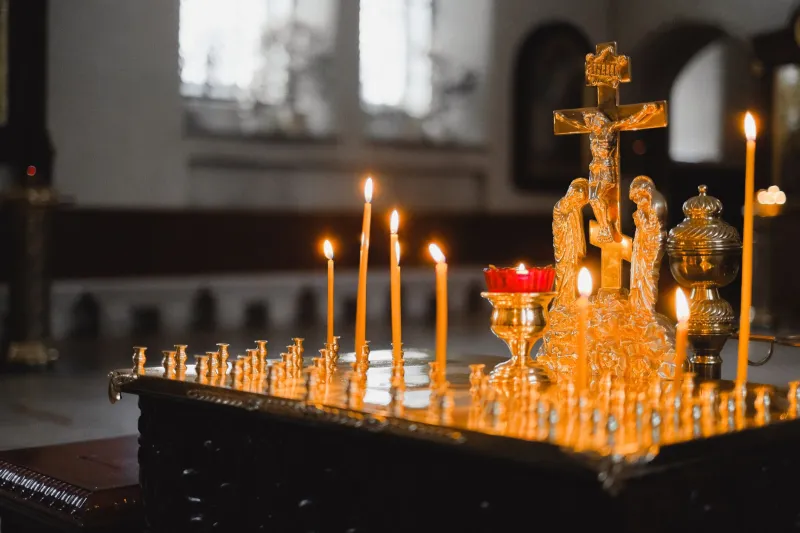
Father Aleksandar wraps up our conversation by pointing to the candles burning near the entrance of his church. People come in off the street sometimes, he says, just to light one. They don't always know why.
"That's okay," he says. "The door is open. We're here. Whatever they're looking for, maybe they find some of it. Maybe they come back. Maybe they don't. But the candle burns either way."
There's something very Balkan about that answer — unhurried, unsentimental, quietly certain. The tradition has been here for a long time. It'll be here after the trend cycle moves on. And in the meantime, the communities that carry it are doing what they've always done: holding space, keeping the calendar, and leaving the door open for whoever needs to walk through it.