No Laptops, No Rush, No Problem: The Kafana Is Coming for Your Local Coffee Shop
Walk into most American coffee shops and you'll find the same scene: people hunched over laptops, AirPods in, receipts for $7 lattes sitting next to productivity journals. The vibe is less "community gathering place" and more "remote office with better lighting." You get your drink, you find a corner, you perform busyness.
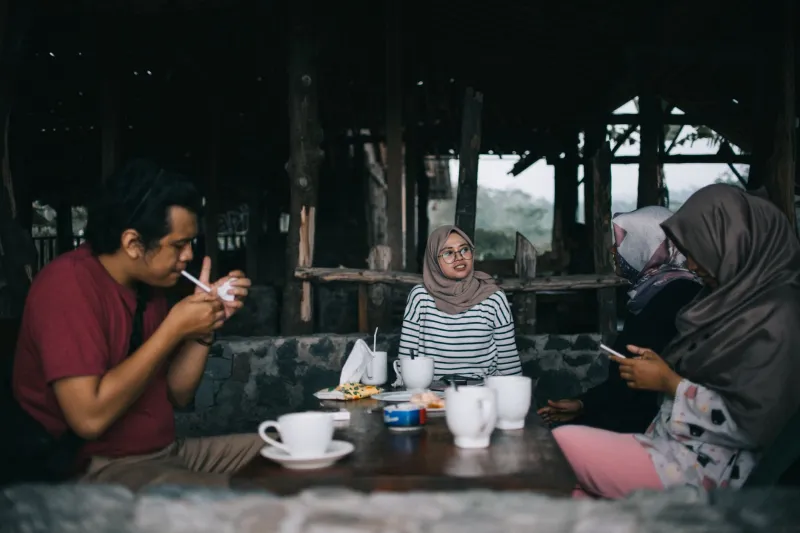
Now walk into Kafana Stari Grad, tucked into a side street in Astoria, Queens, on a Tuesday afternoon. The tables are full. Nobody has a laptop open. Three guys in their sixties are playing cards in the back. Two young women who've clearly been there for hours are laughing over their second round of džezva coffee. The owner, Dragan, is behind the bar having an argument with a regular about soccer — the kind of argument that's actually just a long friendship expressed loudly.
There's no Wi-Fi password posted on the wall. When a first-timer asks for it, Dragan smiles. "We don't have Wi-Fi," he says. "Talk to somebody."
What a Kafana Actually Is
The kafana — roughly translated as "coffeehouse" or "tavern," depending on the context — is one of the most important social institutions in Balkan culture. It's not a restaurant exactly, not a bar exactly, not a café in the Western European sense. It's more like a living room that belongs to everybody. You come in, you sit down, and the expectation is that you'll be there for a while. Hours, maybe. Nobody is rushing you out the door to turn the table.
The drinks are strong — Turkish-style coffee brewed in a džezva, maybe rakija if the afternoon is going that way — and the food, if there is any, is the kind that takes time to eat. Grilled meats. Bread. Ajvar. Things you share.
But the real product being served in a kafana has always been time. Specifically, unstructured time with other people. The Balkan concept of "sitting" — sedenje — carries a whole social philosophy inside it. You sit with people. You talk. You disagree. You laugh. You let the conversation go wherever it goes. There's no agenda.
For a country that treats productivity as a moral virtue, this is basically countercultural.
The Entrepreneurs Behind the Movement
Across American cities with significant Balkan diaspora populations — New York, Chicago, St. Louis, Cleveland, Nashville — a new generation of entrepreneurs is opening spaces that deliberately channel kafana energy. Some are immigrants who grew up with the real thing. Others are second-generation Balkan Americans who watched their parents recreate it informally in living rooms and decided to build it properly.
Sanja Petrović opened her spot in Chicago's Pilsen neighborhood three years ago after years working in the city's restaurant industry. She'd watched countless café concepts come and go, all optimized for throughput and Instagram aesthetics. She wanted something different.
"I grew up watching my parents and their friends spend entire Sundays at the table," she says. "Just talking. Arguing. Being together. I didn't see that anywhere in the American café world and I thought — why not?"
Her space, which she calls simply Kod Sanje ("At Sanja's"), has no table time limits, no minimum spend after the first hour, and a deliberately limited menu. The coffee is excellent. The rakija selection is serious. The playlist runs from old Yugoslav pop to contemporary Balkan folk without apology.
It took about six months to find its audience. Now it's booked solid on weekends.
Americans Are Hungry for This — They Just Didn't Know It
Here's the interesting part: the kafana revival isn't just attracting Balkan Americans. A significant and growing portion of the clientele at these spots has no Balkan background at all.
The "third place" concept — sociologist Ray Oldenburg's term for the social environments that exist outside home and work — has been a buzzword in urban planning and community design for decades. Americans have been diagnosed, repeatedly, as a society suffering from a third-place deficit. We have plenty of places to buy things and plenty of places to work. We have very few places to just be with other people without a transaction attached.
The kafana, it turns out, is a pre-built solution to a problem American culture has been struggling to articulate.
"I come here because it's the only place I can go alone and not feel alone," says Marcus, a 31-year-old graphic designer who found Kod Sanje through a food blog and now comes every Sunday. "Nobody's trying to sell me anything. Nobody cares what I do for work. I just sit and eventually someone starts talking to me."
That's not an accident. It's a design philosophy.
The Rakija Question
No conversation about kafana culture is complete without addressing the elephant — or rather, the small glass — in the room. Rakija, the Balkan fruit brandy that functions as both welcome drink and social lubricant, occupies a complicated space in the American market.
Some kafana-style spots in the US lean into it fully, applying for full liquor licenses and building rakija menus that could double as educational experiences. Others keep it low-key, serving it informally in the way it's often consumed in the Balkans — not as a bar product but as hospitality.
The legal landscape varies wildly by city and state, and navigating it is one of the main challenges Balkan café entrepreneurs face. But the cultural function of rakija — as a drink that signals "we're not in a hurry, we're among friends" — is something these spaces try to replicate even when the actual spirit isn't on offer.
"The rakija is almost beside the point," says Dragan in Astoria. "It's the attitude it represents. Slow down. You're welcome here. Stay."
Can the Kafana Scale?
Some urban observers are watching this micro-movement with genuine curiosity. In a hospitality industry obsessed with scalability, the kafana model is almost defiantly anti-scale. You can't franchise the vibe. You can't automate the feeling of the owner knowing your name and your coffee order and your opinion on last night's match.
But maybe that's the point. In an era of algorithm-curated everything, a space that resists optimization might be exactly what people are paying for.
The laptops stay home. The conversation stays open. The coffee stays strong.
And if you're lucky, someone at the next table will pull you into an argument about something completely unimportant, and you'll look up two hours later and realize you haven't checked your phone once.
That, right there, is the kafana. And it's coming to a neighborhood near you.