Oceans Between: The Hidden Cost of Growing Up Without Your Baka
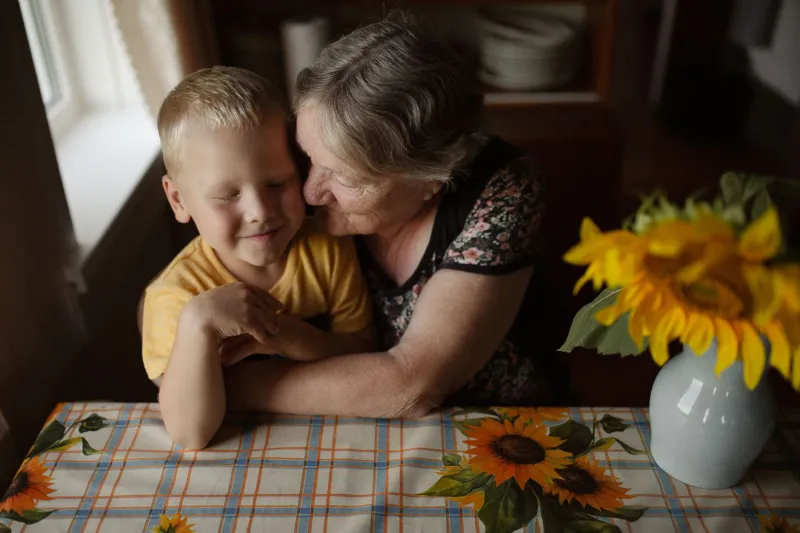
There's a photograph on Leila's refrigerator in Columbus, Ohio, of her daughter Amira at age two, sitting in the lap of an old woman with white hair and enormous hands. The old woman is looking at the child with an expression that has no English word for it — something between ferocious love and peaceful contentment. They are in a village in Bosnia. Amira has not been back since.
Amira is seven now. She knows her baka's face from screens. She knows her voice from Sunday calls that always run long because neither of them wants to hang up. She knows, in the abstract way that children understand things they haven't fully felt yet, that her grandmother loves her more than most things in the world.
What she doesn't know — what she can't know yet — is everything she's missing.
"My baka raised me," Leila says quietly. "I mean that literally. My parents worked. She was there. She fed me, she put me to bed, she told me stories, she taught me things I didn't even realize I was learning until I was an adult. Amira has me and my husband and daycare and a screen on Sundays. It's not the same."
She doesn't say this with self-pity. She says it like someone naming a fact they've made peace with but haven't stopped mourning.
The Baka Economy
In traditional Balkan family structures, grandparents — and particularly grandmothers, the iconic baka — occupied a functional role in child-rearing that went far beyond babysitting. They were the keepers of daily life: cooking, storytelling, language transmission, emotional regulation, cultural memory. In many families, they lived in the same home or nearby, and their presence was so woven into the fabric of childhood that it was invisible, the way air is invisible.
That system worked because everyone lived in the same village, the same town, the same city. Immigration broke the geography, and with it, the system.
The Balkan diaspora in the United States is now multi-generational. There are families where grandparents immigrated decades ago and their grandchildren were born American. There are families where parents immigrated young and their aging parents remained behind. And there are increasingly complex arrangements — aging grandparents who visit for months at a time on tourist visas, grandparents who immigrated late in life and struggle with language and isolation, grandparents who are present digitally but absent physically.
Each configuration carries its own specific set of losses.
The Generation That Missed the Transmission
Ask Balkan American Gen Z what they feel they missed by not having grandparents nearby, and the answers are specific in a way that's almost painful.
"The language," says Nikola, 22, whose grandparents live in Serbia. "My parents both speak Serbian at home, but it's not the same as hearing it from a grandparent. There's a whole register — old expressions, village words, the way they tell a story — that I just don't have. I feel it when I'm in Serbia. Like I'm missing a frequency."
For others, it's the food knowledge. Not recipes — those can be written down, shared in WhatsApp voice messages, demonstrated over FaceTime with a phone propped up against the sugar bowl. It's the embodied knowledge. The way baka's hands knew when the dough was right without measuring. The way she seasoned by instinct rather than instruction. The sensory memory of watching something be made in a kitchen that smelled a specific way, by someone who had made it a thousand times.
"My mom has all of grandma's recipes," says Ana, 25, from St. Louis. "But she'll tell you herself — she doesn't make them the same way. Something is lost. And when grandma is gone, that something is gone permanently."
The Other Side of the Distance
The conversation about grandparent absence tends to center on the children. Less often discussed is what the distance costs the grandparents themselves.
For elderly Balkan immigrants who followed their children to America late in life, the experience can be profoundly disorienting. They arrive to a country whose language they don't speak, whose social world they can't access independently, whose food and streets and rhythms are entirely foreign. They are suddenly dependent in a way they never were at home — where they had community, history, status, friendships stretching back decades.
Dr. Gordana Milić, a geriatric social worker in New York who works extensively with Eastern European immigrant seniors, describes a pattern she sees regularly. "They come because they want to be near their family. But the family is busy. The grandchildren are in school. The parents are working. And the grandparent is sitting in an apartment in a city where they don't know anyone, watching television in a language they don't understand."
"It's a particular kind of loneliness," she adds. "They sacrificed everything to be close to the people they love, and they're still alone."
The grandparents who stayed home face a different version of the same wound. Their children built lives somewhere else. Their grandchildren speak the language imperfectly, if at all. The visits are joyful and too short. The calls are loving and inadequate. They age in the village or the city they've always known, surrounded by everything familiar except the people they most want near them.
Technology Closes the Gap, But Not All the Way
The tools available to transnational families today are genuinely remarkable compared to what earlier immigrant generations had. Video calls mean that a grandmother in Novi Sad can watch her granddaughter's first steps in real time, can sing her a lullaby, can show her how to roll out pastry dough. Digital recipe cards, voice messages, family WhatsApp groups, even shared streaming of the same movies — these are real connective tissues.
And yet.
"FaceTime is a miracle," says Leila. "And it's not enough. My daughter can't crawl into my mother's lap through a screen. She can't smell her. She can't fall asleep next to her. Those things matter. I know they matter because I had them and she doesn't."
There's a particular cruelty in knowing exactly what's missing. First-generation immigrants carry the memory of what full grandparent presence feels like. They can measure the gap precisely. Their children, raised with screens and visits and stories, may not feel the absence as acutely — because you can't grieve something you never fully had.
Whether that's a mercy or its own kind of loss is a question Leila hasn't settled.
What Stays, What Goes
None of this is new, exactly. Every immigrant community in American history has navigated the severing of extended family ties. The Irish, the Italians, the Chinese — all of them rebuilt family structures across oceans and generations, and all of them lost things in the process that were never fully recovered.
What's particular to the Balkan experience, perhaps, is the intensity of the grandparent role in the original culture. The baka wasn't peripheral. She was load-bearing. Her absence doesn't leave a gap at the edges of family life — it leaves a gap at the center.
Amira will grow up loved. She will grow up with culture, with language, with stories and food and a sense of where her family comes from. Her mother will make sure of that.
But somewhere in a village in Bosnia, an old woman with white hair and enormous hands is counting the Sundays between calls, holding a photograph of a two-year-old in her lap, and loving her across an ocean.
Some distances don't close. You just learn to live inside them.